from The White Peacock (I)

The White Peacock (1911), D.H. Lawrence’s first novel, was inspired by a painting, “An Idyll” painted by Maurice Greiffenhagen in 1891. Lawrence proclaimed that the painting had “a profound effect” on him. He later wrote, “As for Greiffenhagen’s ‘Idyll’, it moves me almost as if I were in love myself. Under its intoxication, I have flirted madly this Christmas.” I explore this effect in the second half of this essay.

Here, there is another painting under scrutiny by Lawrence, in the same chapter (III) as the “Idyll” reference, titled “A Vendor of Visions”, young Leticia (or “Lettie”) Tempest denounces her beau’s brother, George Beardsall, as a provincial. George is part of a love triangle with Lettie and Leslie Beardsall. Lettie, subsequently (and unhappily) marries Leslie, but will remain sexually drawn to George. In the third chapter, they sit in a drawing room where she retrieves her collection of art books.

Prior to this, she has been a tease. She tells George “you are only a boy.” She yields her own sense of feminine mystery in a coy and effectual manner. She is protected by a ring of chaperones and the creature comforts of opulence and tradition. She lacks for naught but experience, to which she flirts with a sensate desire to succumb, yet holds herself back.

Lettie toys with recklessness. She frivolously plays on doomed George’s desire for wanting more out of life. He can never escape her fixed grasp on his heart and his life will never be fulfilled as long as she coyly taunts him with what he will never have.

After she carries in a great pile of art books, he tells her that she is “strong.”

“I know how a man will compliment me by the way he looks at me”–she kneeled before the fire. “Some look at my hair, some watch the rise and fall of my breathing, some look at my neck, and a few–not you among them–look me in the eyes for my thoughts. To you, I’m a fine specimen, strong! Pretty strong! You primitive man!”

But George must reach through the fire to seize the gem. Lettie must reach through the gem stone of George to seize the fire she desires so cravenly.

For Lettie, she feels that her superiority, her cultured upbringing, is a tool that she can yield over George’s haplessness. She is condescending, despite likely knowing that she could just as easily be over her head. The other women present, Lettie’s mother, Alice and Sybil all hint that he is “slow.” There is a distinct feeling of “otherness” here. Alice quips to George, “your people,” as if he rose from some other inferior race that they find charming, like a trained ape juggling balls in a Victorian drawing room.

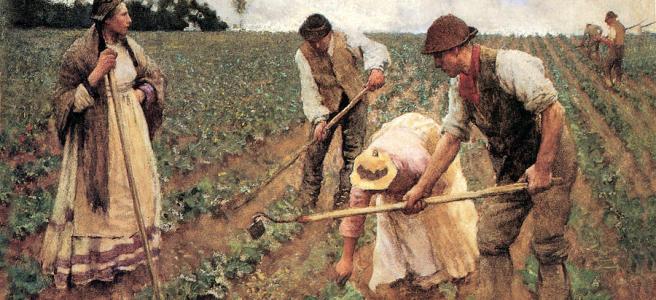
Lettie sits with George and flips through the pages of an art book. When she arrives to George Clausen’s watercolor of peasants hoeing for turnips, she uses the opportunity to square George off for his seeming lack of culture:

“You’d be just that colour in the sunset,” she said, thus bringing him back to the subject, “and if you looked at the ground you’d find there was a sense of warm gold fire in it, and once you’d perceived the colour, it would strengthen till you’d see nothing else. You are blind; you are only half-born; you are gross with good living and heavy sleeping. You are a piano which will only play a dozen common notes. Sunset is nothing to you–it merely happens anywhere. Oh, but you make me feel as if I’d like to make you suffer. If you’d ever been sick; if you’d ever been born into a home where there was something oppressed you, and you couldn’t understand; if ever you’d believed, or even doubted, you might have been a man by now. You never grow up, like bulbs which spend all summer getting fat and fleshy, but never wakening the germ of a flower. As for me, the flower is born in me, but it wants bringing forth. Things don’t flower if they’re overfed. You have to suffer before you blossom in this life. When death is just touching a plant, it forces it into a passion of flowering. You wonder how I have touched death. You don’t know. There’s always a sense of death in this home. I believe my mother hated my father before I was born. That was death in her veins for me before I was born. It makes a difference–“

George doesn’t know how to respond. He is, Lawrence writes, “like a child who feels the tale but does not understand the words.”

She asks George if he is “bewildered,” and he seems very much so, until she flips the page and he is confronted with “An Idyll.”

There…” he states, and here the table turns on Lettie, for she has indeed tread too deep into uncharted waters.

Read more from the White Peacock (II).
from The White Peacock (II)

In D.H. Lawrence’s first novel, The White Peacock, we have the two, George and Lettie, looking at pictures in an art book. She first shows him Clausen’s painting of peasants hoeing turnips (see previous blog post). He then sees and reacts to the painting (much like Lawrence after seeing it and consequently wrote the first of three drafts of his first novel, The White Peacock).

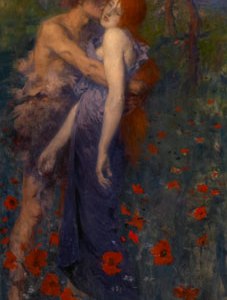
It is Maurice Greiffinhagen’s “An Idyll” (1891).

The obsession with the painting by Lawrence is very much in accordance with Dostoevsky’s obsession with Holbein’s painting of the dead Christ lying in his tomb (which influenced the writing of The Idiot).

The following exchange takes place between George and Lettie:

They turned on, chatting casually, till George suddenly exclaimed, “There!”

It was Maurice Greiffinhagen’s “Idyll”.

“What of it?” she asked, gradually flushing. She remembered her own enthusiasm over the picture.

“Wouldn’t it be fine?” he exclaimed, looking at her with glowing eyes, his teeth showing white in a smile that was not amusement.

“What?” she asked, dropping her head in confusion. “That–a girl like that–half afraid–and passion!” He lit up curiously.

“She may well be half afraid, when the barbarian comes out in his glory, skins and all.”

“But don’t you like it?” he asked.

She shrugged her shoulders, saying, “Make love to the next girl you meet, and by the time the poppies redden the field, she’ll hang in your arms. She’ll have need to be more than half afraid, won’t she?”

It is a scene fraught with sexual tension. Lettie possibly feels that George is brutish (unlike his brother and her beau, Leslie) and therefore unresponsive to things like art and sunsets, as she claims he is when she shows him the Clausen painting.

Response to art is irregardless of social class. It is reactive. It incites in George the very feeling stirring between them. Lettie feels that should she fall under a similar opium-daze, that he would take brutally take advantage of her: “by the time the poppies redden the field, she’ll hang in your arms. She’ll have need to be more than half afraid.

The painting itself which hangs in the National Liverpool Museum, a lusty shepherd firmly embraces a yielding maid on a slope of pasturage. Despite the abundant display of female nudity in many of the paintings surrounding it in the High Victorian gallery at the Walker Art Gallery, such explicit embracing scenes are rare.

The shepherd is seen taking the young maiden with a sudden powerful movement. Her body slumps powerless in his arms. The fairness of her skin contrasts with his swarthy skin tones. He, like George, seems to be a man accustomed to working outdoors. She is a parlor princess, perhaps out on a walk unchaperoned.

Her expression may be seen as ecstatic, but it seems more likely that she is surrendering to the young man’s passion than actively participating in the act of embracing. Should she had taken on a more active role, it would have been unacceptable to a Victorian audience.

The woman’s complacency and her serene rapturous gaze captures the passionate spontaneity of the moment.

Greiffenhagen’s reliance on color as the painting’s expressive medium is striking. The vibrant warm red of the poppies splayed at the lovers’ feet contrasts with the wash of blues and greens in the background. The execution of the work is evident in loose and quick brushstrokes. The artist develops form through color much like a French Impressionist.

Lawrence’s obsession with the painting is well-documented. In 1929 he declared
“all my life I have gone back to painting, because it gave me a form of delight that words can never give.” ‘An Idyll’ embodied passion for him.

He was utterly fascinated by the painting, confessing in a 1908 letter that “the painting moved me almost as much as if I had fallen in love myself.” He made three copies of ‘An Idyll’, one of which he began drawing the night his mother died in 1910.

‘An Idyll’s” appearance in The White Peacock is as sudden and rapturous as George toward Lettie. The painting stirs passionate feelings in George which Lettie is at odds to compensate. Only moments before she had denounced him as a man unable to properly appreciate a sunset. When he suddenly reacts to “An Idyll,” she is taken aback by his response.

His critique of the maiden in the painting mirrors Lettie’s emotional being at that moment: “a girl like that–half afraid–and passion!”

It is almost a case of aesthetic arrest, like Joyce’s Dedaulus glimpsing a young woman bathing in a stream. The frenzied wayward journey of passion leads straight to the heart, with tributaries branching off to the loins and eyes:

He was breathlessly quivering under the new sensation of heavy, unappeased fire in his breast, and in the muscles of his arms. He glanced at her bosom and shivered.

It is as though the two had come across a dirty picture in the midst of an album of family photos. Awkwardly they must quantify their barely-disguised passion for each other, but also, suppress it with Victorian-era modesty. Lettie is quick to denounce him as a provincial. She is unable to appreciate his genuine interaction with the painting, which is the very goal of art itself, to stir a response.

“Didn’t you know the picture before?” she said, in a low, toneless voice.

He shut his eyes and shrank with shame.

“No, I’ve never seen it before,” he said.

“I’m surprised,” she said. “It is a very common one.”

“Is it?” he answered, and this make-belief conversation fell. She looked up, and found his eyes. They gazed at each other for a moment before they hid their faces again. It was a torture to each of them to look thus nakedly at the other, a dazzled, shrinking pain that they forced themselves to undergo for a moment, that they might the moment after tremble with a fierce sensation that filled their veins with fluid, fiery electricity. She sought, almost in panic, for something to say.

“I believe it’s in Liverpool, the picture,” she contrived to say.

He dared not kill this conversation, he was too self-conscious. He forced himself to reply, “I didn’t know there was a gallery in Liverpool.”

“Oh yes, a very good one,” she said.

They are loaded guns, both unable to shoot straight, or at all. Lawrence’s mastery of the novel form is in full display here, like the peacock of the title. The hallmarks of his emerging strength as a writer is evident. He is able to evoke both the masculine and feminine aspects convincingly. Lawrence inhabits both the male and female sensibility, kindling a fire that must either be extinguished or built to full flame. Lettie opts for the former, taking the art books and leaving the room, but still aware of her power over George. Her Exit Stage Left sees her holding the books just below her breasts, as if by accentuating them she can still bring George’s fervor to an even higher pitch.

“Their eyes met in the briefest flash of a glance, then both turned their faces aside. Thus averted, one from the other, they made talk. At last she rose, gathered the books together, and carried them off. At the door she turned. She must steal another keen moment: “Are you admiring my strength?” she asked. Her pose was fine. With her head thrown back, the roundness of her throat ran finely down to the bosom, which swelled above the pile of books held by her straight arms. He looked at her. Their lips smiled curiously. She put back her throat as if she were drinking. They felt the blood beating madly in their necks. Then, suddenly breaking into a slight trembling, she turned round and left the room.”

Reading this last night, it only built my appreciation for Lawrence even more, that every work of his, either as a budding novelist, or later, when his heart threatened to become more jaded and his sensibilities bruised by a life of penury and hardship, never extinguishes his ever-burning flame of kindled desire and satiation.

When Lettie sees George out the door, he takes her hand: “They smiled again at each other, and, with a blind movement, he broke the spell and was gone.”

For his troubles, George marries the wrong woman and eventually slides into alcoholism and suicide. Lettie too marries the wrong brother.

A spell. That’s what it is. Lawrence was under a spell with “An Idyll.” George, the same. Lettie under a spell of passionate yearning from George’s response, and myself from reading all of it.