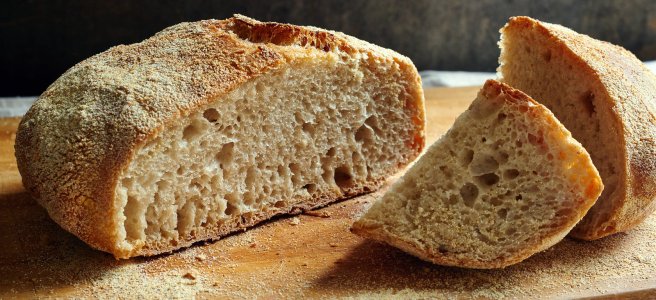
Thoreau on Bread

Thoreau writes in reply to H. G. O. Blake’s letter of 27 March 1848:

“We must have our bread.” But what is our bread? Is it baker’s bread? Methinks it should be very home-made bread. What is our meat? Is it butcher’s meat? What is that which we must have? Is that bread which we are now earning sweet? Is it not bread which has been suffered to sour, and then been sweetened with an alkali, which has undergone the vinous, acetous, and sometimes the putrid fermentation, and then been whitened with vitriol? Is this the bread which we must have? Man must earn his bread by the sweat of his brow, truly, but also by the sweat of his brain within his brow. The body can feed the body only. I have tasted but little bread in my life. It has been mere grub and provender for the most part. Of bread that nourished the brain and the heart, scarcely any. There is absolutely none even on the tables of the rich. 

The Sons of Anak: Henry David Thoreau and John Brown

The Sons of Anak

Concord, Massachusetts – Fall 1859

“It is only when we forget all our learning that we begin to know.”
— Journal, October 4, 1859

On September 5, 1859, Concord was seasonably cool after strong winds (those that pelted the fifty-six-year-old Emerson’s yard with unripe pears),[1] prevailed two days previous. Green urgent sprouts of corn emerged from Concord’s fertile loam and pumpkins, “yellow and yellowing,” blazed the earth creating what Thoreau described as a “genuine New England scene.”[2]

On this day, Thoreau sauntered through the Acton woods searching for a millstone suitable for crushing plumbago into the fine powder he sold to electrotyping firms. (An advertisement in local newspapers of the day states: “PLUMBAGO Prepared EXPRESSLY FOR ELECTROTYPING by JOHN THOREAU, PENCIL MAKER, CONCORD MASS.”) The business was a responsibility inherited (along with the lead mill) solely by Thoreau after the passing of John Sr. in February 1859. Within the first weeks of that year, Thoreau had initiated a period that would begin and end with the presence of death, that of his father and, in December, a distant acquaintance named John Brown.

Read the rest of my new essay on Henry David Thoreau at EMPTY MIRROR.