“Jesus said to him, “Truly I say to you that this very night, before a rooster crows, you will deny Me three times.” – Matthew 26:34
As Adam (8)
Writer – Photographer – Visual Artist
“Jesus said to him, “Truly I say to you that this very night, before a rooster crows, you will deny Me three times.” – Matthew 26:34
“And what He has produced for you in the earth varying in hue, verily, in that is a sign for a people who are mindful.” – The Qur’an

“Never complain of the worlds.” – Upanishads (Seventeenth Kavanda)

“Just so, great king, is rebirth without transmigration.” – The Question of King Milinda (Book III, Ch. 5)
“We are satisfied, O Light of the world, to hear this prediction; we are pleased, O Tathâgata, as if sprinkled with nectar.” – The Lotus Sutra (Ch. 9)

“From that same germ of plants the tree of all germs was given forth, and grew up in the wide-formed ocean, from which the germs of all species of plants ever increased. And near to that tree of all germs the Gôkard tree was produced, for keeping away deformed decrepitude; and the full perfection of the world arose therefrom.” PALAVHI TEXTS (from Chapter IX)

You know what it is to be born alone,
Baby tortoise!
The first day to heave your feet little by little from
the shell,
Not yet awake,
And remain lapsed on earth,
Not quite alive.
A tiny, fragile, half-animate bean.
To open your tiny beak-mouth, that looks as if it would
never open
Like some iron door;
To lift the upper hawk-beak from the lower base
And reach your skinny neck
And take your first bite at some dim bit of herbage,
Alone, small insect,
Tiny bright-eye,
Slow one.
To take your first solitary bite
And move on your slow, solitary hunt.
Your bright, dark little eye,
Your eye of a dark disturbed night,
Under its slow lid, tiny baby tortoise,
So indomitable.
No one ever heard you complain.
You draw your head forward, slowly, from your little
wimple
And set forward, slow-dragging, on your four-pinned toes,
Rowing slowly forward.
Wither away, small bird?
Rather like a baby working its limbs,
Except that you make slow, ageless progress
And a baby makes none.
The touch of sun excites you,
And the long ages, and the lingering chill
Make you pause to yawn,
Opening your impervious mouth,
Suddenly beak-shaped, and very wide, like some suddenly
gaping pincers;
Soft red tongue, and hard thin gums,
Then close the wedge of your little mountain front,
Your face, baby tortoise.
Do you wonder at the world, as slowly you turn your head
in its wimple
And look with laconic, black eyes?
Or is sleep coming over you again,
The non-life?
You are so hard to wake.
Are you able to wonder?
Or is it just your indomitable will and pride of the
first life
Looking round
And slowly pitching itself against the inertia
Which had seemed invincible?
The vast inanimate,
And the fine brilliance of your so tiny eye,
Challenger.
Nay, tiny shell-bird.
What a huge vast inanimate it is, that you must row
against,
What an incalculable inertia.
Challenger,
Little Ulysses, fore-runner,
No bigger than my thumb-nail,
Buon viaggio.
All animate creation on your shoulder,
Set forth, little Titan, under your battle-shield.
The ponderous, preponderate,
Inanimate universe;
And you are slowly moving, pioneer, you alone.
How vivid your travelling seems now, in the troubled
sunshine,
Stoic, Ulyssean atom;
Suddenly hasty, reckless, on high toes.
Voiceless little bird,
Resting your head half out of your wimple
In the slow dignity of your eternal pause.
Alone, with no sense of being alone,
And hence six times more solitary;
Fulfilled of the slow passion of pitching through
immemorial ages
Your little round house in the midst of chaos.
Over the garden earth,
Small bird,
Over the edge of all things.
Traveller,
With your tail tucked a little on one side
Like a gentleman in a long-skirted coat.
All life carried on your shoulder,
Invincible fore-runner.
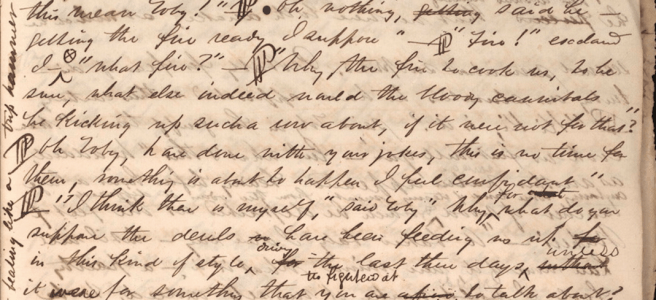
I have been rereading Hershel Parker’s foreword to his “Kraken” edition of Pierre. There is a compelling story of a man (Melville) driven to the brink of pure unmitigated creation on the heels of Moby-Dick, but also he is in near servitude having to pay back debts.
The letter to Nathaniel Hawthorne spills out the purity of his intent, where his mind was at and how it ultimately clashed with the marketplace.
His June 1851 letter to Hawthorne is premonitious of where the direction of his life and art were going… nowhere, at least in his lifetime:
“I did not think of Fame, a year ago, as I do now. My development has been all within a few years past. I am like one of those seeds taken out of the Egyptian Pyramids, which, after being three thousand years a seed and nothing but a seed, being planted in English soil, it developed itself, grew to greenness, and then fell to mould. So I. Until I was twenty-five, I had no development at all. From my twenty-fifth year I date my life. Three weeks have scarcely passed, at any time between then and now, that I have not unfolded within myself. But I feel that I am now come to the inmost leaf of the bulb, and that shortly the flower must fall to the mould.”
Melville is writing for himself here . . . his horse-out-of-the-stall barnstorm of prose assaults the unsuspecting mid-19th century reader and baffles the critics. They label him “crazy.”
Melville’s rendering of a bucolic setting is at once unsettling and calming:
“Not a flower stirs; the trees forget to wave; the grass itself seems to have ceased to grow; and all Nature, as if suddenly becomes conscious of her own profound mystery, and feeling no refuge from it but silence, sinks into this wonderful and indescribable repose.”
It conjures Ralph Waldo Emerson, or some such transcendentalist-type with tree-stump for a pulpit musings all a-prayer under a Concord canopy of firs and pines.
No sooner than the Emersonian vibes subside than Shakespeare is roused:
“The verdant trance lay far and wide; and through it nothing came but the brindled kine, dreamily wandering to their pastures, followed, not driven, by ruddy-cheeked, white-footed boys.”
It’s Melvillean prose poetic in its import, elucidated with certainty:
The verdant trance
lay far and wide;
and through it nothing came
but the brindled kine,
dreamily wandering to their pastures,
followed, not driven,
by ruddy-cheeked,
white-footed
boys.
For me, if the book made no sense at all, its the reality-TV thrill of Melville throwing caution to the four winds in an act of intellectual rebellion. Its Melville pissing on the marketplace. Moby-Dick was his catharsis, expelling the whirlwinds of grief and hate and proclaiming to Nathaniel Hawthorne that he was now “spotless as a lamb” after having written a “wicked book.” If only we could all undergo such radical self-therapy! Melville, self-medicated by the tempestuous whims of his artistry! Begone Valium and Paxil! Open the mind and your ass will follow… the mad earnest scribbles at the end of his beard, page after page with his door locked against domestic disturbances.
In light of this, Melville sensed with a third-eye approach the encroaching clouds of “annihilation.” Visionaries like him were not long for this world and are typically doomed to obscurity or death, or both. Certainly Melville the square peg did not fit in a country hell-bent to spearhead the world in its brick-by-brick construct of industrialism. So, in 1856, he is blunt, honest and forthright to literary comrade, Nathaniel Hawthorne: “I have pretty much made up my mind to be annihilated.”
It is an annihilation long overdue, stemming from an inflexible personal moral conflict (the same that haunted Jack Kerouac, and who saw comfort in Melville’s mindset during the writing of Pierre in the disastrous critical aftermath of Moby-Dick, when Kerouac came to his own creative crossroads sitting in a VA bed in Brooklyn, hiding from an ex-wife seeking a paternal blood test and after having written his long-scroll version of On the Road in April ’51 and now on the verge of cresting his creative solution in “sketching” resulting in his masterpiece, Visions of Cody).
What am I writing then in this blog missive? A fan letter to Herman Melville?
This is the loin-rushing thrill of a young man (or woman) excitedly extolling the aesthetic merits of a new beau . . . this is the same thrill Kerouac found in Melville’s staunch selfishness in writing for his own mind and not for the book stalls of the Victorian marketplace. This is relief and calm, that it all makes sense now after the Dostoyevskian bloodletting resulting in the kind of writing best suited for absinthe hangovers. Melville finds solace in Shakespeare and takes him in both arms as he plunges deep where only “krakens” dare to swim, in the unblinking dark of the hell-hound depths.
There is a back history that I could never hope to relay as eloquently and fresh-eyed as Hershel Parker does in Melville Biography: An Inside Narrative (I can’t recommend a book highly enough and that he has my name in his acknowledgments only binds me evermore to greatness!). Chapter 3’s “Entangled By Pierre” says it all.
Parker is entranced as a young man in the greatness of Pierre, not at a polished mahogany desk in a stifling hot classroom, but on the “naked polished linoleum kitchen floor.” The passage reminds us of finding that one book in your youth that cracked open our consciousness and released the thrill of personal discovery into our youthful spillways.
Parker is sustained by a “rapturous state” during his 1959 Christmas break. And isn’t that what we all cherish and secretly attain once more, that sustained nighttime reading marathon where there is no responsibility tomorrow, but that of personal indulgence? He had followed Moby-Dick with Pierre hoping for a similar experience, not expecting Pierre to surpass its greatness. Parker had been reading Shakespeare, much as Melville did preceding the composition of Pierre and was thereafter “hyperalert” to Shakespeare’s characters and language. Upon reading Pierre, Parker, in his own words, became “obsessed,” much as we are within the hormonal throes of a new love, when the whole world opens up and the possibilities become infinite.

Once I was a child I looked upon the world as an eyeflash of hope – shatters of stars thrown across the night sky, I said to myself that that is where I will be someday.
that is where I’ll be someday
And that I wondered about those stars, and wrote on papers, multiplying my age by tens and wondering where I would be at each point, who would I be? who would I love? who would love me? and I wondered if I would be rich? well-liked? Poor? Scorned?
I had no fears. I loved the world, even when I felt they did not love me back.
But then the first of those decades struck me – a strange ruffling wind tossing me over the sea under a night sky born anew and still there was hope because hope had yet to be born, writhing in its placenta, rueing a fierce-eyed tenacious grip, clinging to a vestige of what I felt to be the right path.
However, that path was but illusion. I walked it fearlessly, regardless of destiny. I had youth on my side, and in youth there are days to burn like tinder, one twig after another until the pile becomes depleted and we scrounge for more to keep the fire burning.
And then the people came, because I had never noticed them before. They had faces that all looked alike, as they do now, not any of significance, but rejoicing in their commonality, the pale fish-eyed thin-lipped galley slaves rowing to the rhythm of commerce, to each wanting the glimmering sheaf of light on the other shore, the other shore not their freedom, or their salvation, but what they can own, what they can have, driving picket fences into the earth to shut others out and bloat flatulently under rich fruit trees regarded itself as a bounty of the earth, and not the property of a tenant. And the ripe fruit drops and decays into the earth.
The dreams of the child become the dashed hope of the ogre-spector of adulthood. Eyes are grim, skin turns to gray, wrinkles crease a riverbed of woes across the astonished face and others, and even others still, use that frightened disbelief as another peg for commerce. Ah! With those fears, like many others, I can capitalize on vanity, insecurity and old age. I eat greed with my lust, eat lust with my greed. On Sundays I pray to be a better person, so that I can step back into the poisoned river and begin my workweek anew.
The child that wondered stands at the precipe of decades later, astonished still at his reflection, that of the startled mirror unmitigating in its refusal to reflect what we want to see. We have allowed ourselves to become slaves to numbers.
Age is our whipping post.
It has become the monster at the end of our youthful dreams. The Hegira from child to adult is but a trail of glass-shattered tears.
He turns. Lights off. Dreams no longer a melodious cargo, but an embargo on our past, taxed and regulated for the blank-face masses. We drag our feet to the grave and stand looking down into an open stinking pit. The moneymakers are waiting to push you in and take more. We have allowed ourselves to be vessels for others to capitalize on, from the individual to that Hydra called government.
Astonished we have no other recourse but to step in.

Let me show you, she said.
She sat on the bed and opened a shoe box and removed a handful of photographs, dustwiping two and offered them smiling: a little girl on a horse; a woman seafoamed and glittering sprinting in the hot sand. ‘These are me,’ she said in a cloud of yellow morning, breathing in hot rushes an infold of warm colors and darkness and light.
She was so there she was so there … ‘these are me,’ and she knowing already that was once was, now was no more except what was captured photographically, almost a betrayal, to defy the past.
Silhouetted she entered. I smelled her before seeing her felt her before I knew her – perfume hangs the air aura-like.
I entered and saw her before I smelled her and knowing it was her and so I closed the door to her closed the door to her…
Fred accosts me on the street and asks about real estate prospects. I cannot entertain his earthly offers, your head must be in the sun, my friend, and I tell him of her, and that she is not here, she is there, across the way standing at the coastline where the picture was taken, and so I look across to a sea rush roar seducing a chain of broken islands and she is waving in the high dark where the foghorn soaks a somber deathblow bellow….
I wade to follow through a street of strangers, a sea of strangers an irrepressible tide of unkindly strangers amassed in colors and hostile energy, billowing folds of a cloth stirred by wafts of dirty hot air rushing toward me, through me searching through this world.
Is she here?
 Paul Maher Jr.