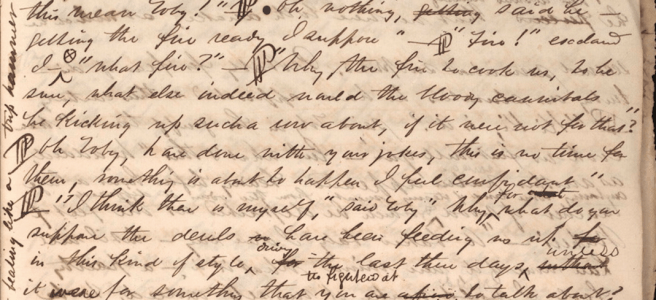
I have been rereading Hershel Parker’s foreword to his “Kraken” edition of Pierre. There is a compelling story of a man (Melville) driven to the brink of pure unmitigated creation on the heels of Moby-Dick, but also he is in near servitude having to pay back debts.
The letter to Nathaniel Hawthorne spills out the purity of his intent, where his mind was at and how it ultimately clashed with the marketplace.
His June 1851 letter to Hawthorne is premonitious of where the direction of his life and art were going… nowhere, at least in his lifetime:
“I did not think of Fame, a year ago, as I do now. My development has been all within a few years past. I am like one of those seeds taken out of the Egyptian Pyramids, which, after being three thousand years a seed and nothing but a seed, being planted in English soil, it developed itself, grew to greenness, and then fell to mould. So I. Until I was twenty-five, I had no development at all. From my twenty-fifth year I date my life. Three weeks have scarcely passed, at any time between then and now, that I have not unfolded within myself. But I feel that I am now come to the inmost leaf of the bulb, and that shortly the flower must fall to the mould.”
Melville is writing for himself here . . . his horse-out-of-the-stall barnstorm of prose assaults the unsuspecting mid-19th century reader and baffles the critics. They label him “crazy.”
Melville’s rendering of a bucolic setting is at once unsettling and calming:
“Not a flower stirs; the trees forget to wave; the grass itself seems to have ceased to grow; and all Nature, as if suddenly becomes conscious of her own profound mystery, and feeling no refuge from it but silence, sinks into this wonderful and indescribable repose.”
It conjures Ralph Waldo Emerson, or some such transcendentalist-type with tree-stump for a pulpit musings all a-prayer under a Concord canopy of firs and pines.
No sooner than the Emersonian vibes subside than Shakespeare is roused:
“The verdant trance lay far and wide; and through it nothing came but the brindled kine, dreamily wandering to their pastures, followed, not driven, by ruddy-cheeked, white-footed boys.”
It’s Melvillean prose poetic in its import, elucidated with certainty:
The verdant trance
lay far and wide;
and through it nothing came
but the brindled kine,
dreamily wandering to their pastures,
followed, not driven,
by ruddy-cheeked,
white-footed
boys.
For me, if the book made no sense at all, its the reality-TV thrill of Melville throwing caution to the four winds in an act of intellectual rebellion. Its Melville pissing on the marketplace. Moby-Dick was his catharsis, expelling the whirlwinds of grief and hate and proclaiming to Nathaniel Hawthorne that he was now “spotless as a lamb” after having written a “wicked book.” If only we could all undergo such radical self-therapy! Melville, self-medicated by the tempestuous whims of his artistry! Begone Valium and Paxil! Open the mind and your ass will follow… the mad earnest scribbles at the end of his beard, page after page with his door locked against domestic disturbances.
In light of this, Melville sensed with a third-eye approach the encroaching clouds of “annihilation.” Visionaries like him were not long for this world and are typically doomed to obscurity or death, or both. Certainly Melville the square peg did not fit in a country hell-bent to spearhead the world in its brick-by-brick construct of industrialism. So, in 1856, he is blunt, honest and forthright to literary comrade, Nathaniel Hawthorne: “I have pretty much made up my mind to be annihilated.”
It is an annihilation long overdue, stemming from an inflexible personal moral conflict (the same that haunted Jack Kerouac, and who saw comfort in Melville’s mindset during the writing of Pierre in the disastrous critical aftermath of Moby-Dick, when Kerouac came to his own creative crossroads sitting in a VA bed in Brooklyn, hiding from an ex-wife seeking a paternal blood test and after having written his long-scroll version of On the Road in April ’51 and now on the verge of cresting his creative solution in “sketching” resulting in his masterpiece, Visions of Cody).
What am I writing then in this blog missive? A fan letter to Herman Melville?
This is the loin-rushing thrill of a young man (or woman) excitedly extolling the aesthetic merits of a new beau . . . this is the same thrill Kerouac found in Melville’s staunch selfishness in writing for his own mind and not for the book stalls of the Victorian marketplace. This is relief and calm, that it all makes sense now after the Dostoyevskian bloodletting resulting in the kind of writing best suited for absinthe hangovers. Melville finds solace in Shakespeare and takes him in both arms as he plunges deep where only “krakens” dare to swim, in the unblinking dark of the hell-hound depths.
There is a back history that I could never hope to relay as eloquently and fresh-eyed as Hershel Parker does in Melville Biography: An Inside Narrative (I can’t recommend a book highly enough and that he has my name in his acknowledgments only binds me evermore to greatness!). Chapter 3’s “Entangled By Pierre” says it all.
Parker is entranced as a young man in the greatness of Pierre, not at a polished mahogany desk in a stifling hot classroom, but on the “naked polished linoleum kitchen floor.” The passage reminds us of finding that one book in your youth that cracked open our consciousness and released the thrill of personal discovery into our youthful spillways.
Parker is sustained by a “rapturous state” during his 1959 Christmas break. And isn’t that what we all cherish and secretly attain once more, that sustained nighttime reading marathon where there is no responsibility tomorrow, but that of personal indulgence? He had followed Moby-Dick with Pierre hoping for a similar experience, not expecting Pierre to surpass its greatness. Parker had been reading Shakespeare, much as Melville did preceding the composition of Pierre and was thereafter “hyperalert” to Shakespeare’s characters and language. Upon reading Pierre, Parker, in his own words, became “obsessed,” much as we are within the hormonal throes of a new love, when the whole world opens up and the possibilities become infinite.

 Paul Maher Jr.