“The precious gems found in the desert wilds are all from earth engendered; moral conduct, likewise, as the earth, is the great source of all that is good.” – The Fo-Sho-Hing-Tsan-King: A Life of Buddha
As Adam (35)

Writer – Photographer – Visual Artist
“The precious gems found in the desert wilds are all from earth engendered; moral conduct, likewise, as the earth, is the great source of all that is good.” – The Fo-Sho-Hing-Tsan-King: A Life of Buddha
“Do not dwell in the past, do not dream of the future, concentrate the mind on the present moment.” – Buddha

“This is the truth […]” – The Mundaka Upanishad

“The holy moon shines equal on the leper and the lord.” – The Hitopadesa

“And departing from hence, he is born again!” – The Upanishads

You know what it is to be born alone,
Baby tortoise!
The first day to heave your feet little by little from
the shell,
Not yet awake,
And remain lapsed on earth,
Not quite alive.
A tiny, fragile, half-animate bean.
To open your tiny beak-mouth, that looks as if it would
never open
Like some iron door;
To lift the upper hawk-beak from the lower base
And reach your skinny neck
And take your first bite at some dim bit of herbage,
Alone, small insect,
Tiny bright-eye,
Slow one.
To take your first solitary bite
And move on your slow, solitary hunt.
Your bright, dark little eye,
Your eye of a dark disturbed night,
Under its slow lid, tiny baby tortoise,
So indomitable.
No one ever heard you complain.
You draw your head forward, slowly, from your little
wimple
And set forward, slow-dragging, on your four-pinned toes,
Rowing slowly forward.
Wither away, small bird?
Rather like a baby working its limbs,
Except that you make slow, ageless progress
And a baby makes none.
The touch of sun excites you,
And the long ages, and the lingering chill
Make you pause to yawn,
Opening your impervious mouth,
Suddenly beak-shaped, and very wide, like some suddenly
gaping pincers;
Soft red tongue, and hard thin gums,
Then close the wedge of your little mountain front,
Your face, baby tortoise.
Do you wonder at the world, as slowly you turn your head
in its wimple
And look with laconic, black eyes?
Or is sleep coming over you again,
The non-life?
You are so hard to wake.
Are you able to wonder?
Or is it just your indomitable will and pride of the
first life
Looking round
And slowly pitching itself against the inertia
Which had seemed invincible?
The vast inanimate,
And the fine brilliance of your so tiny eye,
Challenger.
Nay, tiny shell-bird.
What a huge vast inanimate it is, that you must row
against,
What an incalculable inertia.
Challenger,
Little Ulysses, fore-runner,
No bigger than my thumb-nail,
Buon viaggio.
All animate creation on your shoulder,
Set forth, little Titan, under your battle-shield.
The ponderous, preponderate,
Inanimate universe;
And you are slowly moving, pioneer, you alone.
How vivid your travelling seems now, in the troubled
sunshine,
Stoic, Ulyssean atom;
Suddenly hasty, reckless, on high toes.
Voiceless little bird,
Resting your head half out of your wimple
In the slow dignity of your eternal pause.
Alone, with no sense of being alone,
And hence six times more solitary;
Fulfilled of the slow passion of pitching through
immemorial ages
Your little round house in the midst of chaos.
Over the garden earth,
Small bird,
Over the edge of all things.
Traveller,
With your tail tucked a little on one side
Like a gentleman in a long-skirted coat.
All life carried on your shoulder,
Invincible fore-runner.

The craving sets in; a consuming desire to sate the insatiate.
I lash at the sky, biting the very wind scoring my heart.
It tells me that what I have, I shall forever hold dear.
I have love: she who holds me in darkest night.
I who hold her, in sleeping wakefulness.
I feel it radiate, this yearning so deep.
The ineffable.
The inexpressible.
As lonely as a train call pealing forth in the wilderness.
Stark eyed in midnight lightning.
Yet how do I describe?
I love her. She reaches to me. Lips lush soft rain dropping on my skin.
She lifts me outside of myself, holding a mirror gesturing lovingly – entering inhabiting the cold stranger peering back.
Tendrils of hair, earth on bare feet.
The heat of thunder drumming the summer dark.
This feeling is here.
Everywhere.
I taste it on my lips, succored like electric honey.
My tongue, washing as nectar down a desert throat.
I long to tell it to the world.
I long to share its glory – gospel leaves falling everywhere.
The theatre of my mind applauds its just reward.
I love her.
I love.
Her.

Once I was a child I looked upon the world as an eyeflash of hope – shatters of stars thrown across the night sky, I said to myself that that is where I will be someday.
that is where I’ll be someday
And that I wondered about those stars, and wrote on papers, multiplying my age by tens and wondering where I would be at each point, who would I be? who would I love? who would love me? and I wondered if I would be rich? well-liked? Poor? Scorned?
I had no fears. I loved the world, even when I felt they did not love me back.
But then the first of those decades struck me – a strange ruffling wind tossing me over the sea under a night sky born anew and still there was hope because hope had yet to be born, writhing in its placenta, rueing a fierce-eyed tenacious grip, clinging to a vestige of what I felt to be the right path.
However, that path was but illusion. I walked it fearlessly, regardless of destiny. I had youth on my side, and in youth there are days to burn like tinder, one twig after another until the pile becomes depleted and we scrounge for more to keep the fire burning.
And then the people came, because I had never noticed them before. They had faces that all looked alike, as they do now, not any of significance, but rejoicing in their commonality, the pale fish-eyed thin-lipped galley slaves rowing to the rhythm of commerce, to each wanting the glimmering sheaf of light on the other shore, the other shore not their freedom, or their salvation, but what they can own, what they can have, driving picket fences into the earth to shut others out and bloat flatulently under rich fruit trees regarded itself as a bounty of the earth, and not the property of a tenant. And the ripe fruit drops and decays into the earth.
The dreams of the child become the dashed hope of the ogre-spector of adulthood. Eyes are grim, skin turns to gray, wrinkles crease a riverbed of woes across the astonished face and others, and even others still, use that frightened disbelief as another peg for commerce. Ah! With those fears, like many others, I can capitalize on vanity, insecurity and old age. I eat greed with my lust, eat lust with my greed. On Sundays I pray to be a better person, so that I can step back into the poisoned river and begin my workweek anew.
The child that wondered stands at the precipe of decades later, astonished still at his reflection, that of the startled mirror unmitigating in its refusal to reflect what we want to see. We have allowed ourselves to become slaves to numbers.
Age is our whipping post.
It has become the monster at the end of our youthful dreams. The Hegira from child to adult is but a trail of glass-shattered tears.
He turns. Lights off. Dreams no longer a melodious cargo, but an embargo on our past, taxed and regulated for the blank-face masses. We drag our feet to the grave and stand looking down into an open stinking pit. The moneymakers are waiting to push you in and take more. We have allowed ourselves to be vessels for others to capitalize on, from the individual to that Hydra called government.
Astonished we have no other recourse but to step in.

Let me show you, she said.
She sat on the bed and opened a shoe box and removed a handful of photographs, dustwiping two and offered them smiling: a little girl on a horse; a woman seafoamed and glittering sprinting in the hot sand. ‘These are me,’ she said in a cloud of yellow morning, breathing in hot rushes an infold of warm colors and darkness and light.
She was so there she was so there … ‘these are me,’ and she knowing already that was once was, now was no more except what was captured photographically, almost a betrayal, to defy the past.
Silhouetted she entered. I smelled her before seeing her felt her before I knew her – perfume hangs the air aura-like.
I entered and saw her before I smelled her and knowing it was her and so I closed the door to her closed the door to her…
Fred accosts me on the street and asks about real estate prospects. I cannot entertain his earthly offers, your head must be in the sun, my friend, and I tell him of her, and that she is not here, she is there, across the way standing at the coastline where the picture was taken, and so I look across to a sea rush roar seducing a chain of broken islands and she is waving in the high dark where the foghorn soaks a somber deathblow bellow….
I wade to follow through a street of strangers, a sea of strangers an irrepressible tide of unkindly strangers amassed in colors and hostile energy, billowing folds of a cloth stirred by wafts of dirty hot air rushing toward me, through me searching through this world.
Is she here?
The White Peacock (1911), D.H. Lawrence’s first novel, was inspired by a painting, “An Idyll” painted by Maurice Greiffenhagen in 1891. Lawrence proclaimed that the painting had “a profound effect” on him. He later wrote, “As for Greiffenhagen’s ‘Idyll’, it moves me almost as if I were in love myself. Under its intoxication, I have flirted madly this Christmas.” I explore this effect in the second half of this essay.
Here, there is another painting under scrutiny by Lawrence, in the same chapter (III) as the “Idyll” reference, titled “A Vendor of Visions”, young Leticia (or “Lettie”) Tempest denounces her beau’s brother, George Beardsall, as a provincial. George is part of a love triangle with Lettie and Leslie Beardsall. Lettie, subsequently (and unhappily) marries Leslie, but will remain sexually drawn to George. In the third chapter, they sit in a drawing room where she retrieves her collection of art books.
Prior to this, she has been a tease. She tells George “you are only a boy.” She yields her own sense of feminine mystery in a coy and effectual manner. She is protected by a ring of chaperones and the creature comforts of opulence and tradition. She lacks for naught but experience, to which she flirts with a sensate desire to succumb, yet holds herself back.
Lettie toys with recklessness. She frivolously plays on doomed George’s desire for wanting more out of life. He can never escape her fixed grasp on his heart and his life will never be fulfilled as long as she coyly taunts him with what he will never have.
After she carries in a great pile of art books, he tells her that she is “strong.”
“I know how a man will compliment me by the way he looks at me”–she kneeled before the fire. “Some look at my hair, some watch the rise and fall of my breathing, some look at my neck, and a few–not you among them–look me in the eyes for my thoughts. To you, I’m a fine specimen, strong! Pretty strong! You primitive man!”
But George must reach through the fire to seize the gem. Lettie must reach through the gem stone of George to seize the fire she desires so cravenly.
For Lettie, she feels that her superiority, her cultured upbringing, is a tool that she can yield over George’s haplessness. She is condescending, despite likely knowing that she could just as easily be over her head. The other women present, Lettie’s mother, Alice and Sybil all hint that he is “slow.” There is a distinct feeling of “otherness” here. Alice quips to George, “your people,” as if he rose from some other inferior race that they find charming, like a trained ape juggling balls in a Victorian drawing room.
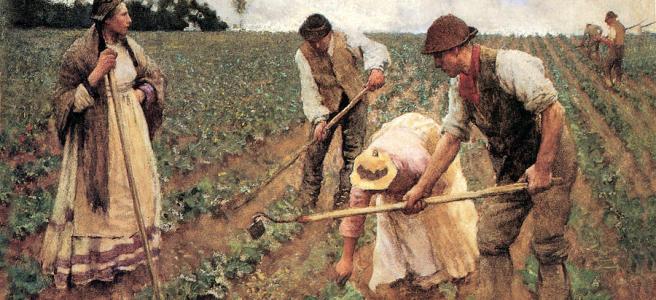
Lettie sits with George and flips through the pages of an art book. When she arrives to George Clausen’s watercolor of peasants hoeing for turnips, she uses the opportunity to square George off for his seeming lack of culture:
“You’d be just that colour in the sunset,” she said, thus bringing him back to the subject, “and if you looked at the ground you’d find there was a sense of warm gold fire in it, and once you’d perceived the colour, it would strengthen till you’d see nothing else. You are blind; you are only half-born; you are gross with good living and heavy sleeping. You are a piano which will only play a dozen common notes. Sunset is nothing to you–it merely happens anywhere. Oh, but you make me feel as if I’d like to make you suffer. If you’d ever been sick; if you’d ever been born into a home where there was something oppressed you, and you couldn’t understand; if ever you’d believed, or even doubted, you might have been a man by now. You never grow up, like bulbs which spend all summer getting fat and fleshy, but never wakening the germ of a flower. As for me, the flower is born in me, but it wants bringing forth. Things don’t flower if they’re overfed. You have to suffer before you blossom in this life. When death is just touching a plant, it forces it into a passion of flowering. You wonder how I have touched death. You don’t know. There’s always a sense of death in this home. I believe my mother hated my father before I was born. That was death in her veins for me before I was born. It makes a difference–“
George doesn’t know how to respond. He is, Lawrence writes, “like a child who feels the tale but does not understand the words.”
She asks George if he is “bewildered,” and he seems very much so, until she flips the page and he is confronted with “An Idyll.”
“There…” he states, and here the table turns on Lettie, for she has indeed tread too deep into uncharted waters.
Read more from the White Peacock (II).
 Paul Maher Jr.